
How to Give a Presentation in English (Non-Native Guide)
Presenting in a second language feels like doing two hard things at once — so remove the guesswork with a plan you can lean on when your heart is racing.
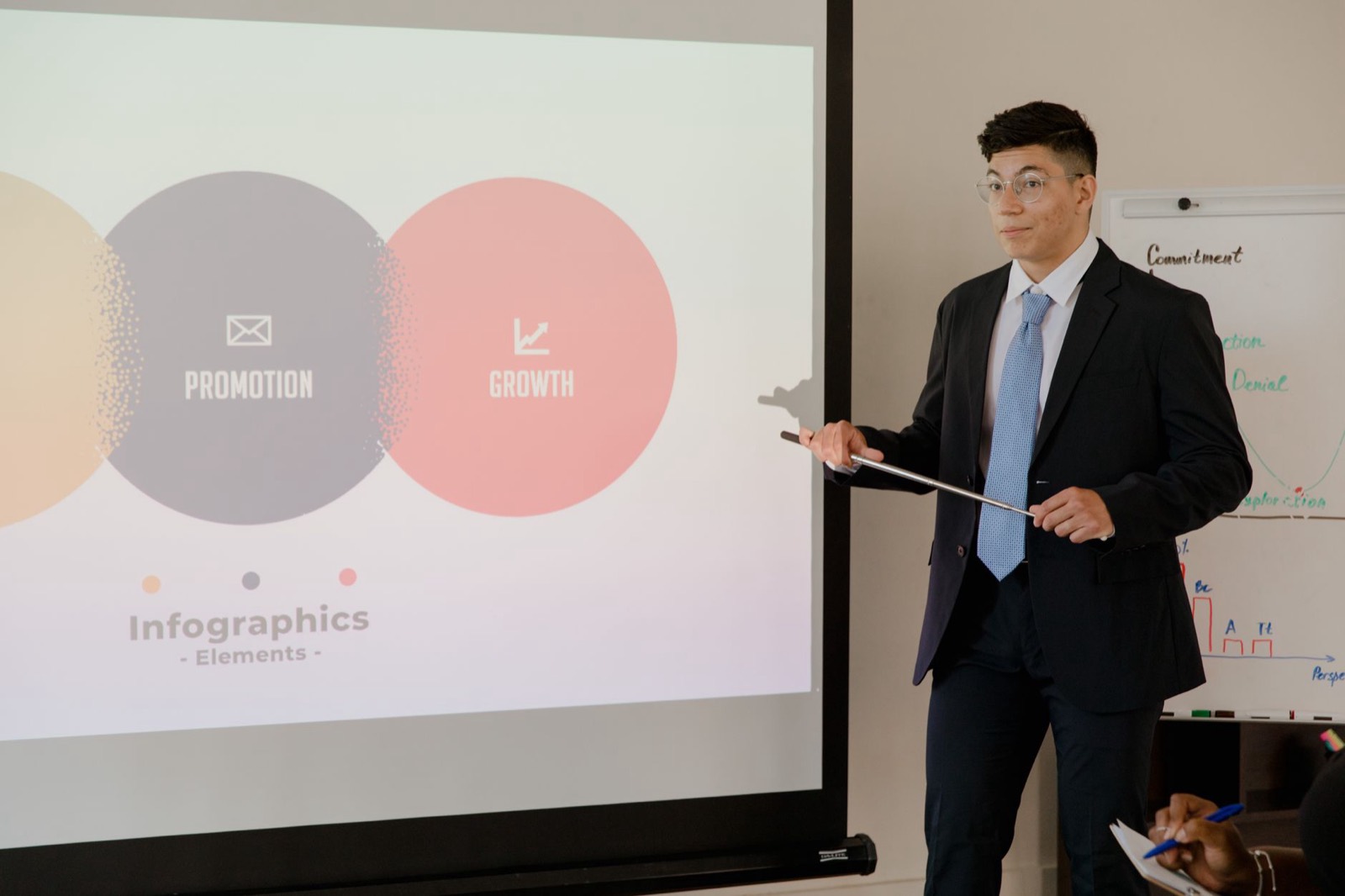
To give a strong presentation in English as a non-native speaker, do four things: structure your talk around an opening hook, three clear points and a firm close; script your opening and closing word for word; slow your pace and pause between ideas so you sound calm and clear; and rehearse out loud — including the questions, not just the slides. None of this requires perfect grammar or a native accent. It requires a plan you can lean on when your heart is racing.
Public speaking in English as a non-native speaker feels like doing two hard things at once — presenting, which unnerves plenty of native speakers too, and doing it in a second language. The trick is to remove as many variables as possible before you stand up. The more of your talk you decide in advance — the shape, the exact first lines, the phrases that carry you from one section to the next — the less you have to invent live, and the more brainpower you free up to actually connect with the room. This guide walks the whole arc: structure, the two scripted moments, delivery, Q&A, and a rehearsal method that works. If nerves are your real blocker, it's worth reading how to overcome the fear of speaking English first, then coming back here.
Structure your talk
A confused audience stops listening. Before you open a single slide, decide the skeleton — and keep it almost embarrassingly simple. The shape that works for nearly any talk is: an opening hook, three clear points, and a close with a call to action. Three is not a magic number, but it's the most people comfortably hold in their heads, and it forces you to cut. If you have seven things to say, they're really three things with detail underneath.
The part non-native speakers most often skip is signposting — the little phrases that tell the audience where you are and where you're going. Signposting does double duty: it guides your listeners, and it gives you a rail to hold on to. When you say "let's move on to my second point," your brain knows exactly what comes next. Keep a small bank of these ready:
- To preview: "Today I'll cover three things…" · "By the end, you'll know exactly how to…" · "Let me start with the big picture, then get into the detail."
- To move between points: "Let's move on to…" · "That brings me to my second point…" · "So that's the problem — now here's what we did about it."
- To highlight what matters: "The key thing to remember is…" · "If you take one thing away today, it's this…"
- To handle a slide or a number: "As you can see here…" · "This is the number that surprised us…"
- To wrap up: "To sum up…" · "So, to bring it all together…" · "Which leaves us with one simple next step."
Write your three points as short, spoken headlines, not paragraphs. You are not reading an essay aloud — you're guiding people through three ideas. If you can say each point in one breath, it's the right length.
Your goal isn't to sound like a native speaker. It's to be clear. A simple structure, spoken slowly with good signposting, beats fluent-sounding rambling every time — and it's far easier to deliver under pressure.
Script the opening and closing
Nerves don't hit evenly across a talk. They spike hardest in the first thirty seconds — before you've found your rhythm — and again at the very end, when you're tired and want to land the point. So script those two moments word for word. Everywhere else, notes are fine; here, memorise. When you've rehearsed the exact first lines, you start on autopilot, and momentum carries you into the parts you know well.
A reliable opening has three beats: greet, state the topic in one clear sentence, and preview. For example: "Good morning, everyone. Thanks for being here. Today I'll walk you through three things — the problem we found, the solution we built, and the results so far. Let's start with the problem." Notice there's no apology in it. Resist the urge to open with "sorry, my English is not so good" — it lowers the room's expectations and, worse, plants doubt in your own head just as you need confidence. If you want a hook instead of a plain greeting, a short question ("How many of you have ever…?") or a single surprising fact works well and buys you a beat to settle.
The closing mirrors it: signal the end, summarise your three points in one line each, and give one clear next step. "So, to sum up: the problem was X, we did Y, and the result was Z. My ask is simple — let's approve the next phase by Friday. Thank you. I'm happy to take any questions." That last line matters, because it hands you cleanly into the Q&A instead of trailing off into an awkward "so… yeah, that's it."
Delivery for non-natives
Here is the single most useful delivery habit for a second-language speaker: slow down. When we're nervous, we speed up, and speed is the enemy of clarity — it blurs your consonants, swallows your word endings, and gives the audience no time to process an accent they're still tuning into. Pauses feel eternal to you and barely register to them. In fact, a deliberate pause reads as confidence, not hesitation. Silence after a key point tells the room "that mattered — let it land."
A few concrete techniques that make a big difference:
- Chunk your sentences. Speak in short groups of words with tiny pauses between them, instead of one long unbroken stream: "Our sales / went up / by twenty percent / in the first quarter." Chunking gives you time to breathe and the listener time to follow.
- Stress the key word in each sentence. English rides on stressed words. Decide which word carries the meaning and lean on it: "This is the fastest option, but not the cheapest." Flat, evenly-weighted speech is exactly what makes people sound robotic — if you tend to sound flat, our guide on why you sound monotone in English (and how to fix your intonation) is the natural next step.
- Breathe from the bottom of a sentence. Take your breath at the pauses you've built in, not mid-phrase. Running out of air is what makes the ends of sentences fade to a mumble.
- Land your final consonants. Non-native speakers often drop the ends of words. "Nex step" becomes hard to parse; "next step" with a crisp -t is instantly clear. Slowing down makes this almost automatic.
If you're presenting remotely, all of this matters even more, because your audience loses body language and lip-reading cues — we cover that specific case in English for phone and video calls. Either way, don't chase a perfect accent on stage. Clear, well-paced, well-stressed English is understood everywhere; a rushed native-sounding blur is not.
Rehearse your talk out loud with an AI coach
Vora is an AI English coach you talk to like a phone call. Practise your opening, run a mock Q&A, and get a fluency report on your pace and filler words — as many times as you need.
Handle questions without panic
For most non-native speakers, the Q&A is scarier than the talk — because you can't script it. But you don't need to. You need a small set of moves that handle almost any question, and the confidence to know that "let me think about that" is a completely professional thing to say. There are three moves worth drilling.
Buy time, politely. You are allowed a few seconds to think. Nobody expects an instant answer, and reaching for a full sentence in a second language genuinely takes a moment. Use it openly:
- "That's a great question — let me think for a second."
- "Good point. Let me take that in two parts."
- "I want to give you a proper answer, so let me think about how to put it."
Clarify before you answer. If you didn't fully catch the question — or you want more time — repeat it back in your own words. This confirms you understood, and it makes you sound thoughtful rather than caught out:
- "Just to make sure I understand — you're asking about the timeline, is that right?"
- "Sorry, could you rephrase that? I want to answer the right question."
- "So your concern is mainly the cost side — let me speak to that."
Park it when you don't know. You will sometimes get a question you can't answer, and pretending is worse than admitting it. Park it gracefully and move on:
- "I don't have that number in front of me — can I follow up with you after?"
- "That's outside what I prepared today, but I'll find out and email you."
- "Great question for the wider team — let me connect you with the right person."
The same turn-taking skills that get you heard in meetings apply here; if you tend to freeze when the floor opens up, how to speak up in English meetings has more phrases for holding your ground calmly.
Rehearse the way that works
Reading your slides silently in your head is not rehearsal. It feels productive and does almost nothing, because the hard part isn't remembering the content — it's producing the words out loud, in English, under pressure. That's a physical skill, and it only improves by doing the physical thing. Here's a rehearsal routine that actually transfers to the room:
- Rehearse out loud, standing up, at full volume. Whisper-practice and stage-practice are different skills. Say every word as if the audience is there. The first full run always feels clumsy — that's the point of doing it in private instead of live.
- Record yourself and watch it back once. It's uncomfortable, but ninety seconds of playback tells you more than an hour of worrying. You'll immediately hear where you rushed, where you mumbled the ending of a sentence, and which filler word you lean on. Fix the top two things; ignore the rest.
- Rehearse the Q&A, not just the slides. This is the step almost everyone skips and the one that pays off most. Write down the ten questions you most dread being asked, then answer them out loud, cold. Once you've said an answer aloud even once, it stops being terrifying.
- Over-learn the opening. Run your first thirty seconds five times more than anything else. When the start is automatic, the nerves have nothing to grab.
The catch with all of this is finding a patient partner who'll sit through your talk five times and fire hard questions at you. That's exactly the gap an AI coach fills — you can run your opening as many times as you like without embarrassment, throw a mock Q&A at it, and get instant feedback on your pace and filler words, at 6am or the night before. Whatever you rehearse with, the principle stands: the presentation you've said out loud ten times is the one you'll survive. The one you've only read in your head is the one that falls apart.
Frequently asked questions
How do I start a presentation in English?
How can I stop feeling nervous when presenting in English?
What should I say if I don't understand a question in the Q&A?
Walk in ready, not just prepared
Download Vora and rehearse your next presentation with an AI tutor — your opening, your close, and a full mock Q&A. Free trial, no card required.